
A foreign court judgment may be recognised and, provided that the relevant requirements are met, enforced in Switzerland. Judgments originating from states covered by the Lugano Convention are governed by the Convention; most other foreign judgments are primarily subject to the Swiss Federal Act on Private International Law (PILA / IPRG). Where a foreign judgment awards a monetary claim, legal recognition of the judgment alone is generally not sufficient. The creditor must also organise the actual enforcement of the claim under the Swiss Federal Act on Debt Enforcement and Bankruptcy (DEBA / SchKG) and, where the legal requirements are met, consider attaching the debtor’s assets located in Switzerland.
Recognition and enforcement of foreign judgments in Switzerland is therefore the step that, in practice, separates a judgment that exists merely “on paper” from the actual recovery of money from the debtor.
This article focuses primarily on foreign judgments awarding monetary claims. Much has been written about this subject, but many publications remain predominantly theoretical. This overview is different: it draws on my many years of practical experience advising and representing both creditors and debtors. The terminology used in this article follows Swiss legal terminology and may therefore differ slightly from terminology used in other jurisdictions.
When can a foreign judgment be recognised and enforced in Switzerland?
As a practical matter, enforcement in Switzerland becomes particularly relevant where the debtor is located in Switzerland or where the debtor owns assets in Switzerland, such as bank accounts, real estate, interests in companies or other property.
The first connection – the debtor’s residence or registered office in Switzerland – is usually obvious. The second is often underestimated: the debtor does not necessarily have to be based in Switzerland for enforcement proceedings in Switzerland to be relevant. For example, if a creditor holds a Dutch court judgment against a German company that owns assets or production facilities in Switzerland, the creditor may consider enforcement in Switzerland either instead of, or in parallel with, enforcement measures in Germany.
Is it possible to proceed in Switzerland even without a foreign court judgment?
Yes. You have read that correctly: in certain cases, a claim can be enforced in Switzerland without first conducting court proceedings abroad – for example in France, Russia, Ukraine, Poland, the United Kingdom or the United States. The best way to explain this is through a case from my own practice:
- Under a grain supply agreement, the parties had agreed that disputes would be dealt with in London.
- The creditor, registered in Dubai, United Arab Emirates, had delivered the goods.
- The debtor, registered in the Canton of Zug, failed to pay and eventually stopped responding altogether.
- The creditor’s in-house counsel initially instructed British lawyers to commence debt-recovery proceedings in London.
- By the time the creditor approached me, more than six months had passed, and the London recovery proceedings had effectively not yet begun.
- Faced with this delay, the creditor’s in-house counsel contacted me to explore an alternative approach.
- After analysing the case and receiving the mandate for the Swiss proceedings, I prepared and filed an application for Rechtsöffnung with the Cantonal Court of Zug.
- The debtor instructed one of Switzerland’s largest law firms.
- This did not change the outcome: the application was granted in full in Zug. The Swiss proceedings lasted only approximately five months.
- Following the decision of the Cantonal Court of Zug, the parties reached a settlement, and the debtor paid my client’s claim. The London proceedings, which had still not commenced, became unnecessary.
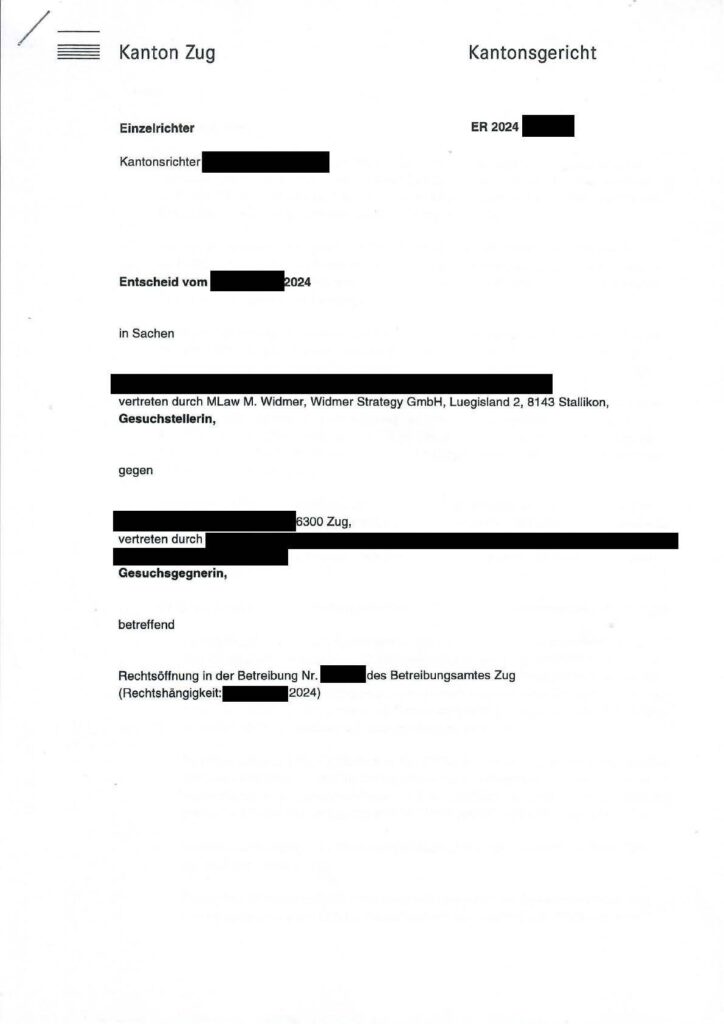
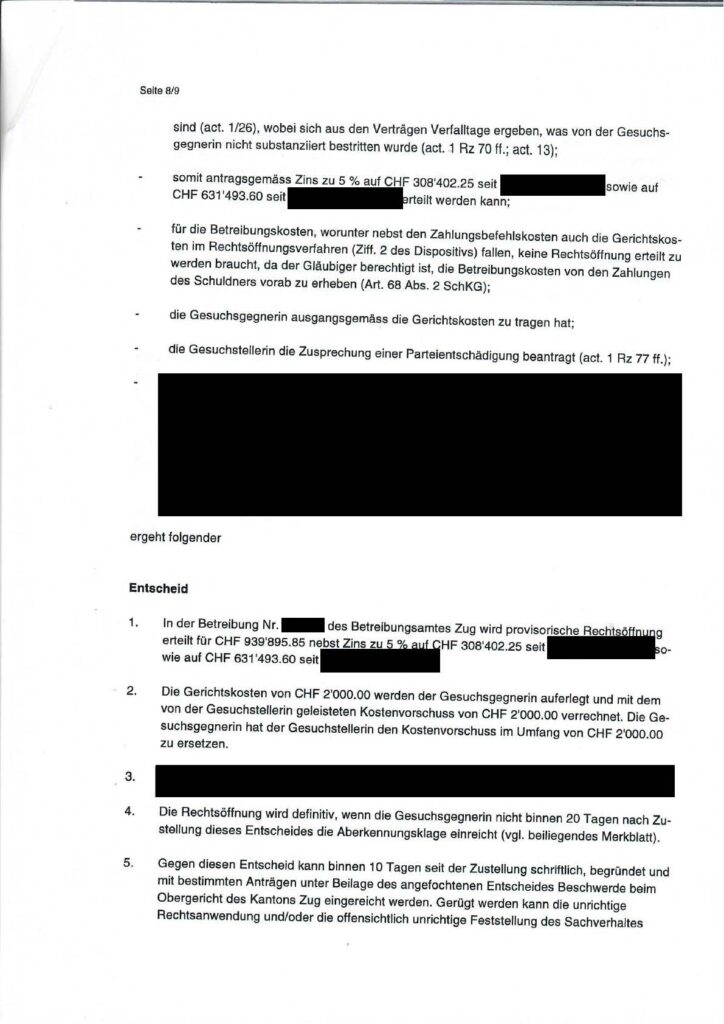
This approach – described by the client as a “manoeuvre” – was possible in particular because of the Swiss Rechtsöffnung procedure. A jurisdiction clause or arbitration clause in a contract does not necessarily exclude Rechtsöffnung proceedings in Switzerland in every case. The decisive factors include the specific document on which the claim is based, the type of Rechtsöffnung that may be available and the circumstances of the individual case.
The case described above illustrates why it can be useful to involve a legal professional familiar with Swiss enforcement law well before a foreign court judgment has been obtained. This may already be appropriate when a dispute first arises – or, ideally, even at the contract-drafting stage.
Contracts and supporting documents can often be structured in a way that facilitates subsequent Rechtsöffnung proceedings, attachment proceedings or other enforcement measures in Switzerland. My philosophy is simple: the best dispute is the one that never arises.
Attachment of assets and legal support – further reasons to obtain Swiss advice early
In many cases, court proceedings abroad will nevertheless be necessary. This does not mean, however, that nothing can be done in Switzerland while those proceedings are pending. At least two issues should be considered in parallel with the foreign litigation.
- where the statutory requirements are met, the possibility of obtaining an attachment order (Arrest) over the debtor’s assets located in Switzerland should be examined. Otherwise, a creditor may successfully win the foreign litigation, subsequently complete the Swiss recognition or enforcement proceedings and then discover that the debtor’s assets have disappeared in the meantime. The requirements for a Swiss attachment order are governed in particular by Articles 271 et seq. of the Swiss Federal Act on Debt Enforcement and Bankruptcy (SchKG / DEBA). I have discussed this subject in detail in a separate article.
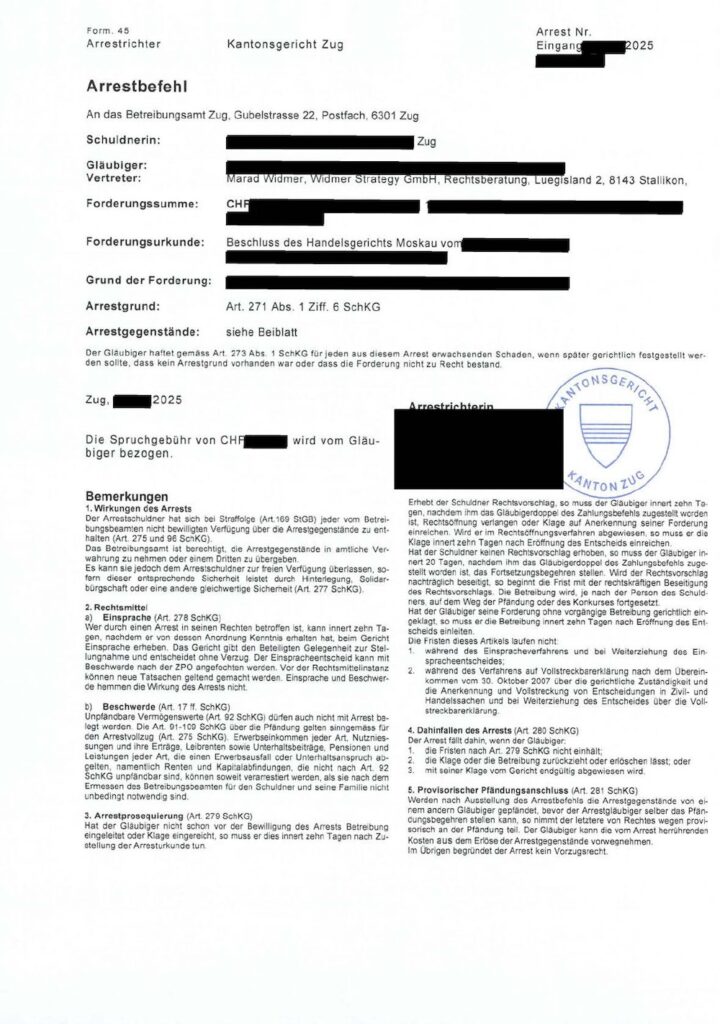
- Second, it can be useful to assess the foreign proceedings, while they are still ongoing, from the perspective of their future recognition and enforcement in Switzerland. I do not, of course, replace the local lawyers conducting the proceedings in the foreign jurisdiction. My role in such situations is to identify, and where possible avoid, issues that may later create obstacles to recognition or enforcement in Switzerland.
Recognition does not mean automatic enforcement
Creditors often obtain a favourable foreign judgment and assume that enforcement in Switzerland is then merely a technical formality.
In practice, the first step is to determine which recognition and enforcement regime applies to the particular judgment. At least two situations must be distinguished. Judgments from states covered by the Lugano Convention are, in principle, recognised in Switzerland without any special recognition procedure (Article 33 of the Lugano Convention). Automatic recognition, however, does not mean automatic compulsory enforcement. For judgments that are not governed by the Lugano Convention or another specific international treaty, recognition is generally assessed primarily under Articles 25–29 of the Swiss Federal Act on Private International Law (PILA / IPRG).
Swiss judgments that are final and enforceable do not require a foreign recognition procedure within Switzerland. Their enforcement takes place within the Swiss enforcement system. A foreign judgment, by contrast, must satisfy the requirements of the recognition and enforcement regime applicable in Switzerland. The key question is therefore not simply:
“Does the creditor have a court judgment?”
The more important question is:
“Can this particular judgment, in these particular circumstances, actually be used to enforce the claim in Switzerland?”
The good news for creditors is that Swiss courts generally do not review the merits of the foreign judgment. A “direct attack” on the substance of the foreign judgment is therefore generally not possible. Simply arguing that the foreign court incorrectly applied substantive law or incorrectly assessed the evidence will normally not allow the underlying dispute to be retried in Switzerland.
The good news for debtors is that this does not mean that no defences are available. Depending on the applicable legal regime, relevant issues may include serious procedural irregularities, incompatibility with another judgment, certain questions concerning the jurisdiction of the foreign court and a violation of Swiss ordre public. Such an “indirect attack” must, however, fall within the statutory grounds for refusing recognition or enforcement. Mere disagreement with the outcome of the foreign proceedings is not sufficient.
For judgments falling within the Lugano Convention, the creditor’s starting position is generally stronger. The Convention is based on mutual trust between its contracting states and provides for recognition without a special recognition procedure. This does not mean, however, that compulsory enforcement is automatic or that the debtor can never rely on objections provided for by the Convention. Even the most favourable recognition regime cannot replace a proper enforcement strategy.
For creditors, important factors include selecting the correct procedure, providing complete documentation, proving that the judgment is final and/or enforceable and acting in good time in relation to the debtor’s assets. For debtors, the key issue is to identify quickly those objections that are actually admissible in Swiss proceedings. For both sides, it may therefore be crucial to involve a specialist familiar with Swiss enforcement practice as early as possible.
If you are a creditor: the objective is generally not merely to have the foreign judgment “recognised”. The real objective is to turn the judgment into money actually recovered in Switzerland. I therefore examine the applicable legal regime, the available documentation, possible Swiss assets of the debtor, the prospects of an attachment order or Rechtsöffnung proceedings and the most direct procedural route to enforcement.
If you are a debtor: the priority is to determine quickly whether there are admissible grounds for resisting recognition or enforcement and which objections may be raised in Rechtsöffnung proceedings, attachment proceedings or other Swiss enforcement procedures. Deadlines in such cases can be short, making an early response particularly important.
A common mistake made by both sides
The recognition and enforcement of foreign judgments in Switzerland is governed by Swiss law and the applicable international treaties. Depending on the case, the principal legal instruments may include the Swiss Federal Act on Private International Law (PILA / IPRG), the Swiss Federal Act on Debt Enforcement and Bankruptcy (DEBA / SchKG), the Swiss Code of Civil Procedure (CPC / ZPO) and the Lugano Convention.
The importance of Swiss procedural rules should not be underestimated. One mistake may, for example, be to entrust Swiss enforcement proceedings to German lawyers who do not have corresponding practical experience with Swiss enforcement procedure. The issue is, of course, neither the nationality of the lawyer nor the country in which that lawyer obtained his or her legal education.
What matters is practical knowledge of Swiss enforcement law and Swiss procedural rules. A party may have a very strong position under substantive law while a procedural mistake may nevertheless have a decisive impact on the outcome. A case from my practice in the Canton of Zurich illustrates this point.
A client for whom I had previously handled tax matters and Swiss naturalization proceedings approached me. His company was the debtor under a contract for the supply of natural fertilisers. The creditor, an offshore company, filed an application for Rechtsöffnung. Although its legal representative was based in Switzerland, he had obtained his legal education outside Switzerland, in Russia. The creditor’s substantive legal arguments were quite serious. However, procedural mistakes had been made in the Swiss proceedings. I relied on these mistakes in my client’s interest and was able to persuade the court to dismiss the application for Rechtsöffnung without the need to examine in detail most of the creditor’s substantive arguments. The creditor did not appeal the decision.
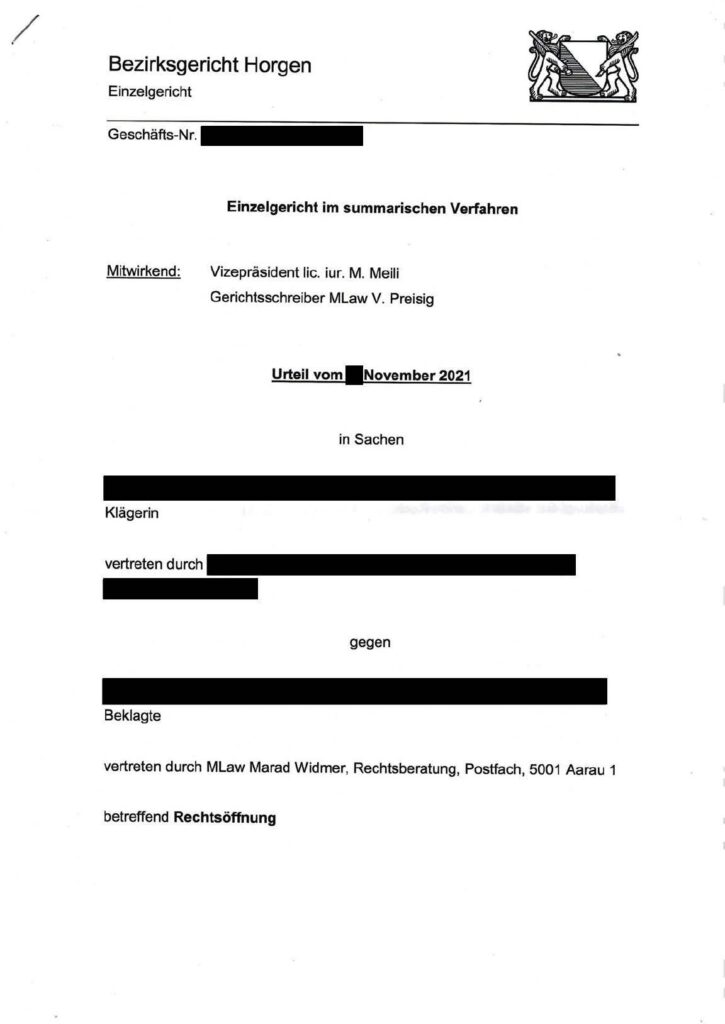
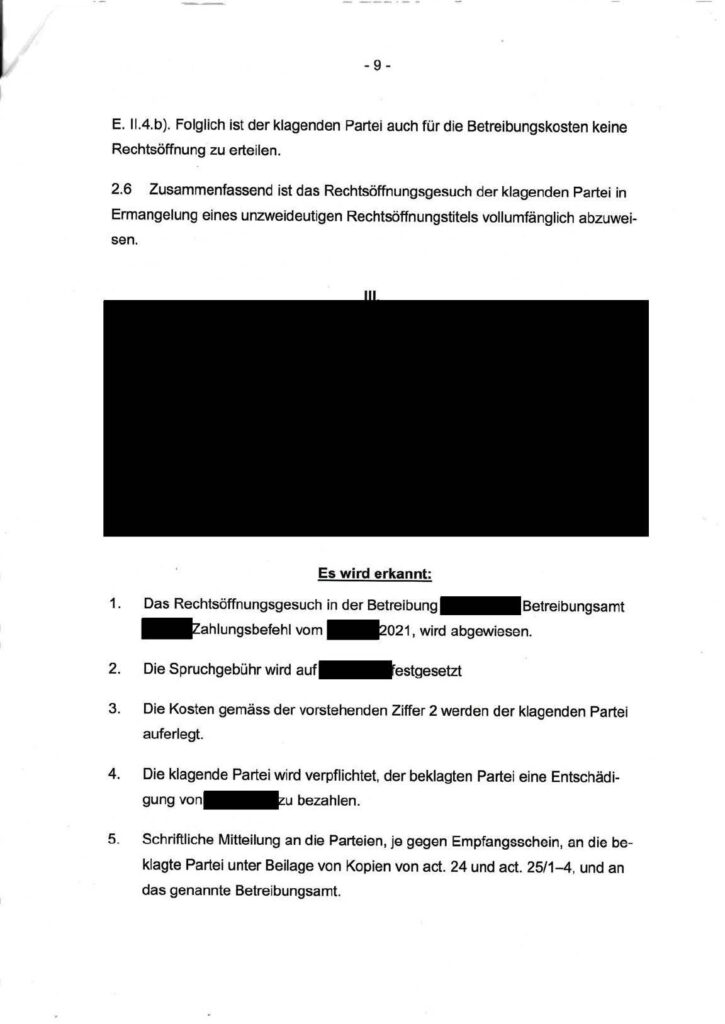
This example is not intended as criticism of foreign legal education. Rather, it illustrates the particular importance of Swiss procedural rules in Rechtsöffnung proceedings: even strong arguments on the merits cannot always cure a procedural error.
What are the most important “precedents” in this field?
Switzerland belongs to the continental European civil-law tradition and does not apply the Anglo-American doctrine of stare decisis. The primary sources of law are legislation and international treaties.
Nevertheless, case law – particularly published decisions of the Swiss Federal Supreme Court – is of considerable practical importance for interpreting PILA, the Debt Enforcement and Bankruptcy Act, the Code of Civil Procedure and international treaties. Federal Court case law therefore has a substantial influence on the approach taken by lower Swiss courts in many areas.
Can an application for recognition and enforcement be filed in English?
No. Court proceedings are conducted in the official language of the competent canton or the relevant court or judicial district. English, Russian or Spanish are not languages of Swiss court proceedings. The required language must therefore be determined by reference to the competent court.
For example, court submissions in the Cantons of Zurich, Zug, Basel-Stadt and Schwyz are filed in German; in Geneva they are filed in French; and in the Canton of Ticino they are filed in Italian. In multilingual cantons, such as Bern, the language of the proceedings may depend on the competent court and judicial district. Foreign documents may also have to be accompanied by translations in the required form.
How long do recognition and enforcement of a foreign judgment in Switzerland take?
The duration depends on various factors, including the applicable legal regime, the debtor’s conduct, the completeness of the documents, any translation requirements, possible appeals and the workload of the competent court. In my experience, a relatively straightforward and well-prepared case can sometimes be completed within approximately 6 months. Where the debtor actively contests the proceedings, complex recognition issues arise or appeals are filed, the overall proceedings may take considerably longer.
Can a decision recognising or refusing to recognise a foreign judgment be appealed?
Yes. As a general rule, an appeal can be brought before the second-instance court – normally the highest competent court of the relevant canton, although its precise name differs from canton to canton. If the statutory admissibility requirements are met, the matter may subsequently be brought before the Swiss Federal Court as the third and final judicial instance. An appeal will, of course, increase the overall duration of the proceedings.
Is it possible to seek recognition of a foreign judgment in Switzerland without immediately seeking enforcement?
Yes. A separate recognition procedure is possible where provided for by law. In cases involving monetary claims, however, the creditor’s ultimate objective is normally not the abstract recognition of the judgment but access to the debtor’s assets. For this reason, a separate recognition procedure is often unnecessary. It may be more efficient to use a procedural route that leads directly towards compulsory enforcement. The precise answer depends, among other factors, on whether the Lugano Convention, PILA or a specific international treaty applies and on the stage reached in the enforcement process.
International arbitration awards
If you hold an international arbitral award rather than a judgment issued by a foreign state court, the award may also be recognised and enforced in Switzerland, provided the relevant requirements are met. Arbitral awards are, however, governed by a different legal regime. Of central importance is the New York Convention of 10 June 1958.
How can I assist?
I am a Swiss legal professional with a complete Swiss legal education – Bachelor’s and Master’s degrees obtained in Bern and Zurich – and have worked for more than ten years, among other areas, with Rechtsöffnung proceedings, attachment proceedings and debt enforcement.
I advise and assist both creditors and debtors in proceedings concerning the recognition and enforcement of foreign judgments and related proceedings in Switzerland. In attachment and Rechtsöffnung proceedings, I am permitted to represent parties before the courts of all Swiss cantons.
If you need to recognise and enforce a foreign court judgment in Switzerland, defend yourself against such enforcement, or obtain advice from a Swiss-law perspective while foreign proceedings are still pending, I would be pleased to hear from you.
Other article languages: DE / RU
Marad Widmer, LL.M. (Geneva), Managing Partner of the Widmer Strategy GmbH. Bachelor and Master in Swiss Law (Universities of Berne and Zurich). Languages: German, English, Russian and Italian. Member of the Swiss Lawyers Association (SJV/SSJ/SSG).